


Geopolitics is the "new norm" in energy policymaking. The central challenge for all actors is to build resilience without losing flexibility. This requires diversifying supply chains, reinforcing electricity infrastructure, and learning to navigate an increasingly fragmented and competitive regulatory world.
Dr Kaho Yu, Head of Energy and Resources Research, Verisk Maplecroft
Laura Schwartz, Senior Asia Analyst, Verisk Maplecroft
Energy has returned to the centre of geopolitics. Conflict continues to expose the vulnerability of major production regions and transport routes, while governments are increasingly using supply restrictions, export controls and access to strategic infrastructure as sources of leverage. At the same time, energy geopolitics is increasingly shaped by clean-energy technologies, artificial-intelligence development and global standards.
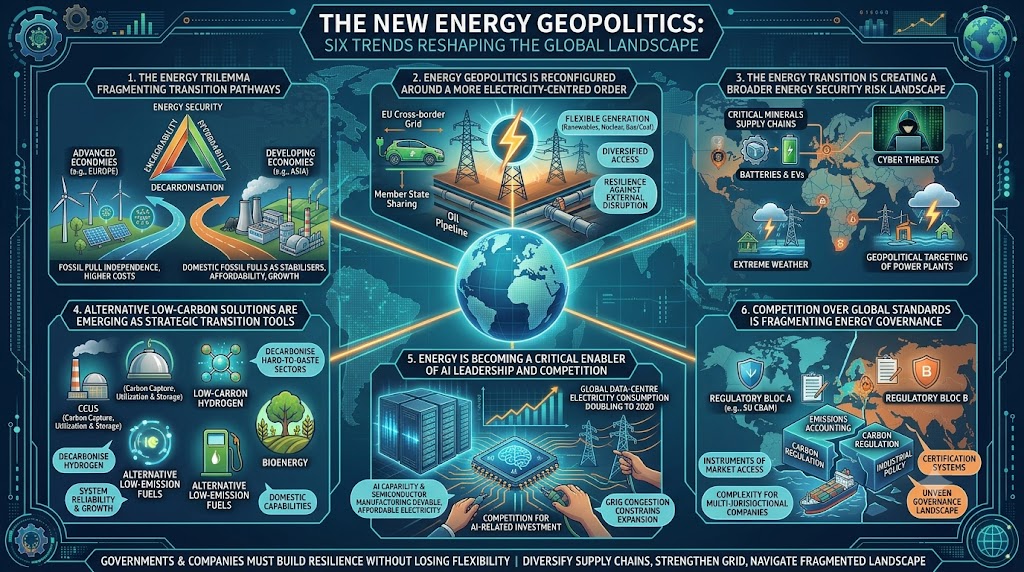
The impact extends well beyond short-term disruptions to oil and gas flows. Geopolitical pressures are changing how states manage the energy trilemma, directing investment towards technologies and infrastructure that support both resilience and strategic advantage. Energy security and transition policy are consequently becoming more closely aligned with industrial, technological and economic priorities. Six trends illustrate how geopolitics is reshaping not only energy markets, but also the pathways, technologies and governance structures shaping the next phase of the energy transition.
1. The energy trilemma is fragmenting transition pathways
Geopolitical pressure is making the energy trilemma more difficult to manage. Governments are seeking to strengthen security of supply while containing costs and sustaining progress on decarbonisation. As these objectives increasingly pull policy in different directions, national transition strategies are becoming more differentiated rather than converging around a common model.
For energy-importing economies, compounding disruptions from the Ukraine crisis to the disruption of Strait of Hormuz have reinforced the need to reduce dependence on individual suppliers, transport routes and fuels. Governments are responding by broadening external supply relationships while expanding domestic energy options. This is accelerating investment in renewable energy sources, as well as nuclear power, in many markets, while for some, energy security and affordability concerns are reinforcing coal use or encouraging greater domestic oil and gas production.
The resulting energy mix varies across countries. In many developing markets, geopolitical disruption has reinforced the role of domestic fossil fuels as stabilisers of the energy system, particularly where renewables or other alternatives cannot yet provide an immediate substitute. Developing market governments tend to prioritise economic growth and industrialisation, amplifying the need to keep energy affordable. These
pressures can slow the displacement of fossil fuels even where renewable deployment is advancing, as seen across much of Asia. Countries such as China and India are therefore expanding cleaner energy while continuing to rely on coal, gas and other conventional fuels to maintain energy system reliability and support economic growth.
Advanced economies are generally pursuing a different pathway. In many European countries, dependence on imported fossil fuels is increasingly viewed as a strategic vulnerability as well as a climate concern. Geopolitical disruption has therefore strengthened support for renewable power, electrification and other non-fossil alternatives, even where the transition requires higher near-term costs. Advanced economies’ policy directions are more clearly oriented towards reducing fossil-fuel dependence, although affordability and industrial competitiveness continue to influence the pace of implementation.
The result is a more fragmented transition landscape globally. Climate objectives may remain broadly shared, but the transition’s pace, sequencing and technology mix will increasingly reflect each economy’s national security priorities, domestic resource availability and capacity to absorb higher costs.
2. Energy geopolitics is being reconfigured around a more electricity-centred order
Energy market shocks caused by the disruption of the Strait of Hormuz are prompting governments to reconsider the limits of an energy security model that has centred primarily on oil and gas for decades. This petro-centric order has rested heavily on geopolitical control over production, exports and transport routes. It is now being overlaid by a more electricity-centred order, in which grid infrastructure, generation capacity and electrification technologies are increasingly important sources of resilience.
This reconfiguration reflects the wider range of domestic options available within an electricity-based system. Electricity can be generated from renewables, nuclear energy, coal or gas, giving governments greater flexibility to adjust the energy mix according to domestic resources and security needs. Greater electrification can therefore partially reduce exposure to imported oil and gas, even where the power mix itself remains carbon-intensive.
Electricity’s growing importance does not imply the near-term replacement of oil and gas, which remain important, particularly for transport, industry and petrochemicals, and power generation in the case of gas. Rather, electricity will assume a larger role within energy policy and investment alongside continued reliance on conventional fuels. Countries with stronger power systems and greater capacity to produce or secure the technologies required for electrification will be better positioned to manage external disruption.
The trend is already visible in Europe and Southeast Asia, although it is taking different forms. The EU’s established cross-border grid provides the foundation for integrating larger volumes of renewable power and sharing electricity across member states. This gives the bloc greater scope to reduce dependence on imported fossil fuels and absorb external energy shocks. In ASEAN, immediate responses to the Iran crisis continue to focus on petroleum supply and emergency coordination, while the longer-term strategy places greater emphasis on regional power integration. If materialised, the ASEAN Power Grid has the potential to connect supply centres with major demand centres across borders, diversify access to generation and reduce part of the region’s exposure to external fuel disruption.
3. The energy transition is creating a broader energy-security risk landscape
As renewable energy and electrification become more central to the energy mix, they are also becoming integral to energy security policy. However, moving away from oil and gas does not remove geopolitical vulnerability, but transfers part of it to the technologies, infrastructure and supply chains underpinning alternative energy systems. Electrification supported by clean energy, for example, shifts energy-security exposure towards critical supply chains, grid infrastructure, cyber threats and extreme-weather risks.
Clean energy supply chains are among the most significant emerging vulnerabilities. Batteries, transmission infrastructure, electric vehicles and renewable-energy technologies depend on minerals whose processing and refining are often concentrated in a limited number of markets. This heightens exposure to export restrictions, licensing requirements, state intervention and resource nationalism, particularly where the same suppliers also dominate intermediate processing and component manufacturing.
Diversifying these supply chains can reduce concentration risk, but it will be costly and slow. New mining and mineral-processing projects involve long lead times and require substantial capital, infrastructure and technical expertise. Building alternative manufacturing capacity is similarly difficult because battery, solar-panel and wind-turbine supply chains depend on established industrial ecosystems. Southeast Asia illustrates these opportunities and constraints. The region’s mineral resources, processing potential and expanding manufacturing base are attracting new partnerships, but policy uncertainty, shifting export rules and uneven regulatory enforcement can slow investment and diversification.
The security challenge also extends to electricity infrastructure, which is increasingly exposure to geopolitical targeting, cyber threats and climate stress. During conflict, power plants, substations and transmission networks can become direct targets, as repeated attacks on Ukraine’s electricity system in recent years have shown. Greater reliance on software, automated controls and remote management also increases
vulnerability to cyber incidents and technical failure. Extreme weather adds further pressure to grid stability and can increase the risk of outages. Recent heatwaves and droughts have strained power systems across European and Asian cities, driving up cooling demand while constraining electricity generation and network performance. As electricity assumes a larger role across transport, industry and digital activity, disruption to the power system will carry wider economic consequences.
4. Alternative low-carbon solutions are emerging as strategic transition tools
The need to balance energy security and energy transition is driving greater policy support and investment in a broader range of low-carbon solutions. Rather than relying primarily on the rapid expansion of renewable power, there are increasing policy focus on options that can reduce emissions in hard-to-abate sectors while retaining the conventional energy capacity required for system reliability and economic growth.
This approach is strengthening support for carbon capture, utilisation and storage (CCUS), low-carbon hydrogen, bioenergy, lower-emission fuels and carbon markets. Together, these options support a more balanced and pragmatic transition by enabling decarbonisation in sectors where renewable electricity cannot provide an immediate or complete substitute. They also give governments greater flexibility over the pace and sequencing of the transition as geopolitical instability increases uncertainty over energy supply, costs and access to key technologies.
These low-carbon solutions are emerging as strategic industries and new sources of investment. Governments increasingly view hydrogen, CCUS, alternative fuels and carbon markets as opportunities to build domestic capabilities, attract capital and secure a position in developing regional value chains. For example, Japan’s Green Transformation strategy explicitly links decarbonisation with industrial renewal and large-scale investment, while Singapore is supporting hydrogen and other low-carbon technologies amid broader new energy and industrial capability development.
However, many of these emerging solutions remain costly, depend on substantial infrastructure investment or require stronger policy and regulatory frameworks. Their climate contributions also vary according to implementation standards, lifecycle emissions and the credibility of monitoring systems. The expansion of low-carbon options will therefore increase flexibility while also placing greater importance on technology governance and project-level integrity.
5. Energy is becoming a critical enabler of AI leadership and competition
Great-power competition for leadership in artificial intelligence is increasing energy’s strategic importance. AI capability depends not only on advanced semiconductors,
computing infrastructure and technical expertise, but also on access to large volumes of reliable and competitively priced electricity. Energy availability is therefore becoming a critical enabler of technological leadership and a growing component of geopolitical competition.
Data centres require large and continuous power supplies, while semiconductor manufacturing, cloud infrastructure and digital networks add further electricity demand. According to the IEA, global data-centre electricity consumption is expected to more than double to around 945 TWh by 2030, with AI as the most important driver. In the United States, data centres are projected to account for almost half of electricity-demand growth to 2030.
As AI and semiconductor development become strategic industrial priorities, competition will increasingly extend from chips and computing capacity to the energy supply required to support them. Countries with sufficient generation capacity, resilient grids and timely access to new connections will be better positioned to attract AI-related investment. By contrast, grid congestion, connection delays and limited reserve capacity may constrain expansion even where capital and technological capabilities are available.
6. Competition over global standards is fragmenting energy governance
Geopolitical competition is increasingly shaping the rules governing the energy transition. Major economies are using carbon regulation, industrial policy and sustainability standards not only to reduce emissions, but also to support domestic industries and influence the development of global supply chains. Measures such as the EU Carbon Border Adjustment Mechanism, sustainable aviation fuel mandates and low-carbon fuel standards show how climate rules are increasingly affecting trade, investment and market access.
Standards are becoming instruments of market access and industrial competition, rather than remaining purely technical tools for safeguarding environmental integrity. Differences in emissions-accounting methodologies, certification systems, sourcing requirements and eligibility rules can determine whether energy and low-carbon products, ranging from biofuels to carbon credits, are eligible for use in regulated markets.
This creates particular challenges for companies operating across multiple jurisdictions. Projects may need to comply with different requirements on embedded emissions, traceability, local content and verification, increasing costs and limiting the ability to sell the same product across markets. Developing economies may face greater difficulties where regulatory institutions, data systems and certification capacity remain limited.
The result is likely to be a more fragmented system organised around competing low-carbon market blocs rather than a fully integrated global framework. In practice,
regulatory alignment may develop more readily within political and commercial partnerships than through universal rules. This will increase the strategic importance of interoperability between major systems, while leaving companies and developing economies to navigate a more complex and uneven governance landscape.
Conclusion
Energy geopolitics is becoming the norm in energy strategy and policymaking, rather than a temporary source of disruption. It will increasingly determine which technologies scale, where capital flows and how quickly transition ambitions can be converted into commercially viable outcomes.
For governments and companies, the central challenge will be to build resilience without losing flexibility. This will require diversifying supply chains, strengthening electricity infrastructure and navigating an increasingly fragmented regulatory landscape, while retaining access to the technologies and investment needed for the transition.